Generated by interaction
Create intelligence from real adversary activity with your own decoys, APIs, MCP server surfaces, services, credentials, and sensitive paths.
Deception-generated threat intelligence
Detect AI agents acting outside their task · Connect approved AI tools through MCP
From interaction to intelligence
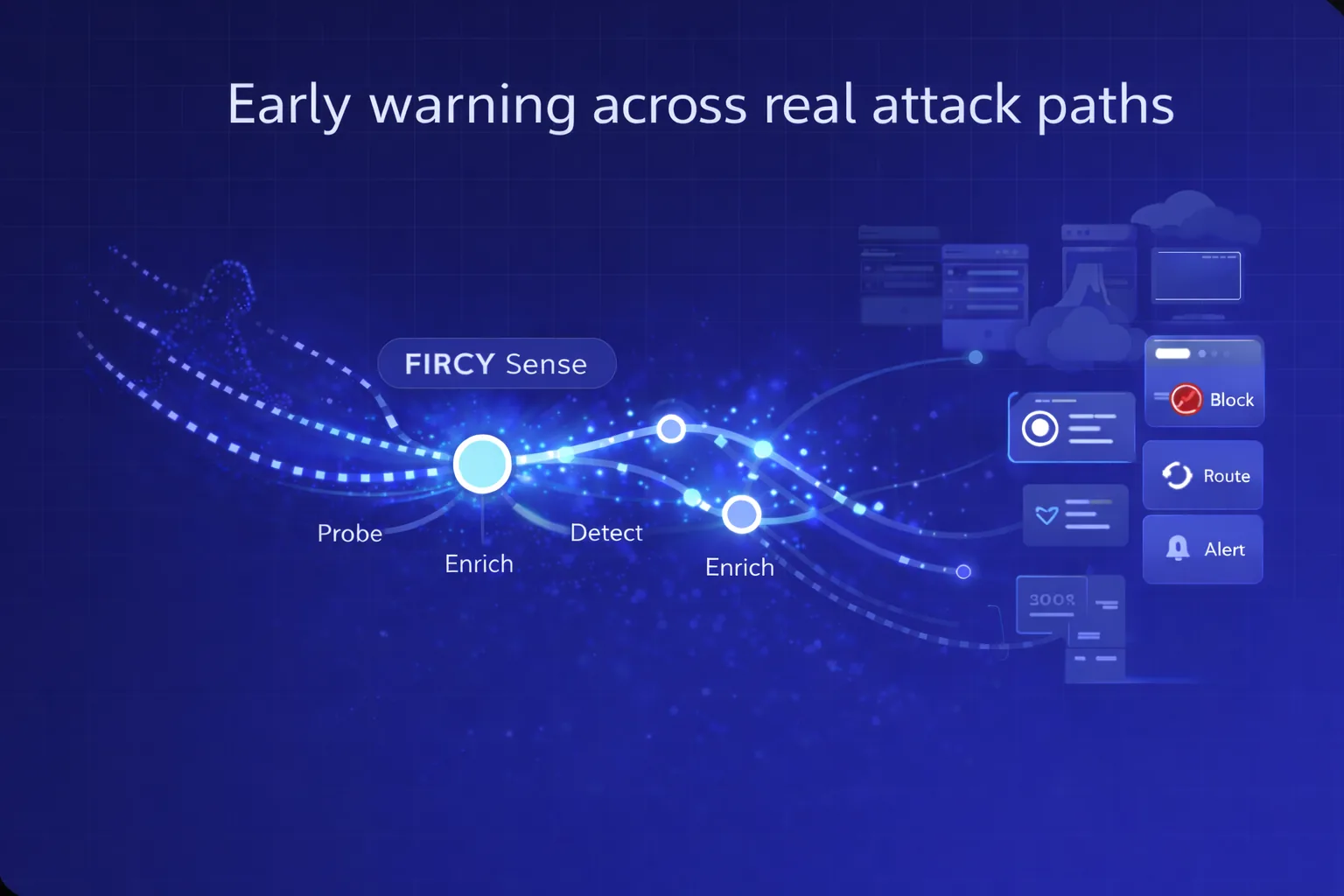
The strongest intelligence begins with controlled evidence: what was touched, where it came from, what it resembled, and what should happen next.
Create intelligence from real adversary activity with your own decoys, APIs, MCP server surfaces, services, credentials, and sensitive paths.
Add network, infrastructure, targeting, behavioural, and historical context without treating every match as the same kind of evidence.
Move validated findings into investigation, hunting, case, automation, and CTI workflows.
AI in FIRCY Sense
Observe suspicious interaction with decoy APIs, MCP surfaces, credentials and documents. Use the available evidence to investigate unknown automation or approved agents operating outside their task, without treating a decoy interaction alone as proof of AI identity or malicious intent.
Where enabled, AI-assisted summaries and follow-up guidance can help analysts explore a finding. Keep generated explanations tied to the evidence and distinguish observed facts from interpretation.
Use the production FIRCY Sense MCP integration to provide approved tools with configured intelligence context for investigation. This is separate from monitoring interactions with decoy MCP surfaces.
What makes it different
Capture evidence from activity that should not normally occur, including what was accessed, tested, followed, reused, or probed.
Show which decoys, services, locations, paths, identities, and themes were touched so the event is tied back to your environment.
Add enough surrounding context for analysts to triage, hunt, escalate, or publish without rebuilding the story from raw events.
How it fits
Threat actors, campaigns, malware, vulnerabilities, infrastructure, and industry targeting still matter.
Deception signals show which lures, credentials, APIs, MCP server surfaces, paths, services, and workflows attracted suspicious interaction.
External context can enrich FIRCY events, while FIRCY events can make external intelligence more relevant to your SOC.
Example outputs
Threat intelligence capabilities
Connect source activity to the specific decoys, APIs, MCP server surfaces, services, application paths, identity artefacts, and sensitive workflows that attracted attention.
Enrich source infrastructure with ownership, network, location, reputation, and historical activity context where available.
Help analysts distinguish evidence that raises concern from infrastructure context that may simply explain what a source is.
Move from a single event into related IP, ASN, service, targeted-asset, and user-agent context so analysts can scope activity more quickly.
Move selected findings into structured intelligence workflows with export, publish, provenance, and policy-aware handling when configured.
From signal to CTI
A source, identity, or actor touches a decoy, credential, path, service, or sensitive workflow that should not be part of normal activity.
The source and behaviour are enriched with infrastructure, targeting, reputation, history, and user-agent context where available.
The event becomes a structured investigation object that can support triage, hunting, publication, or response automation.
For analysts
Summarise recent activity, meaningful patterns, and the events most worth attention.
Review source activity, targeting, risk context, and related environment evidence from one investigation view.
Connect events across time, source, target, and behaviour so a single signal can become a fuller investigation.
Understand when activity emerged, how it developed, and whether it resembles previous activity.
Generate evidence-scoped summaries, next actions, similar-event context, and follow-up answers where enabled.
Export or publish selected findings into downstream intelligence and SOC workflows when the tenant workflow is configured.
Grounded by evidence
FIRCY Sense is careful about the difference between observed evidence, enrichment context, and validated findings. That distinction matters when intelligence is used for investigation or defensive action.
The strongest signal comes from activity around your environment, then enrichment adds context rather than replacing the evidence.
Infrastructure context, reputation, and malicious indicator matches are handled differently so analysts can reason about them properly.
Enrichment, export, publication, and downstream routing depend on the deployment model and tenant configuration.
Generated summaries and follow-up answers can help analysts move faster, while evidence and deterministic workflows remain central.
Make intelligence operational