Expose suspicious touchpoints earlier
Add discreet coverage where attackers probe, authenticate, enumerate, or reach for data.
FIRCY Sense Platform
See the AI-agent use case and the practical detection guide.
Signal flow
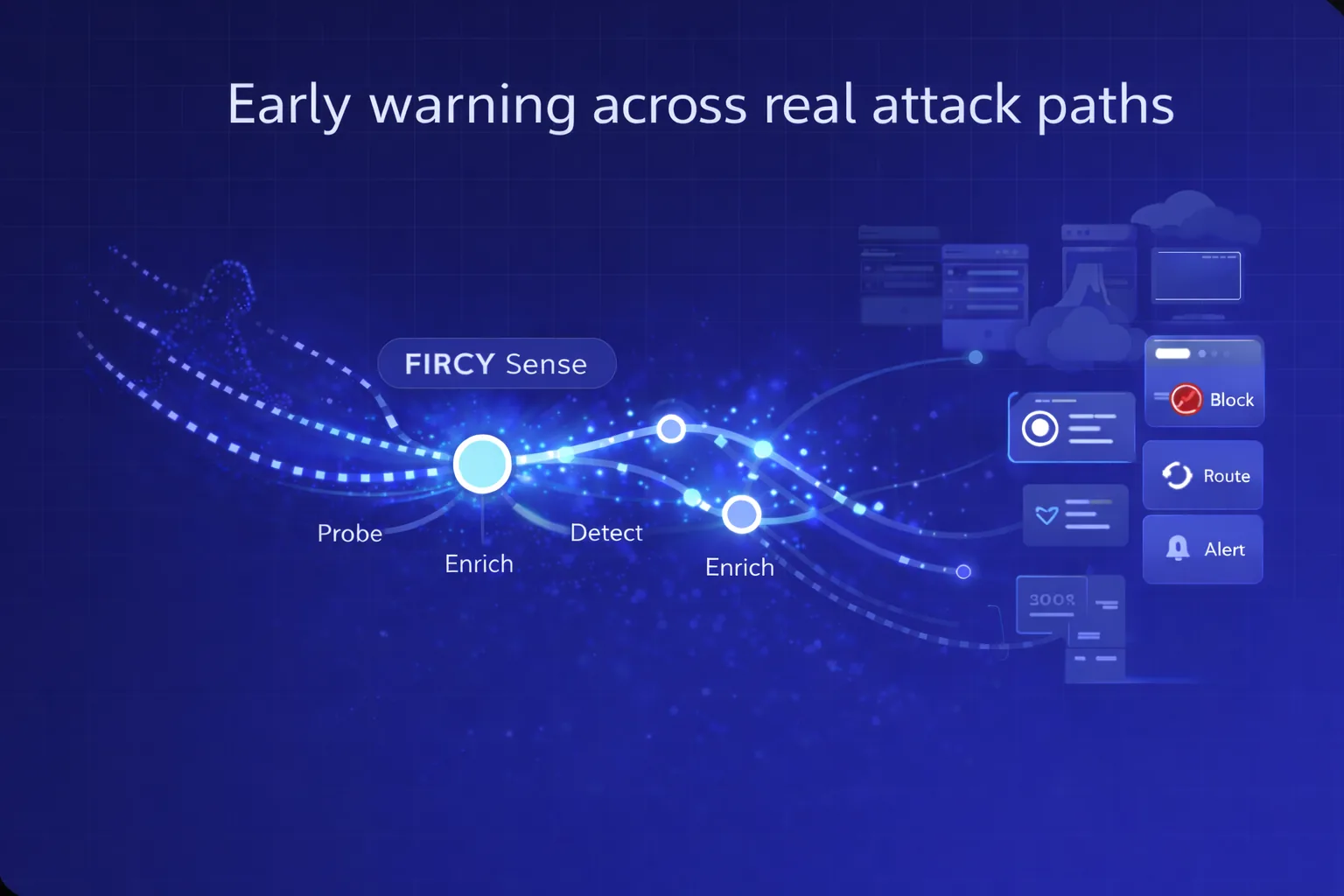
Add discreet coverage where attackers probe, authenticate, enumerate, or reach for data.
Turn interaction into timestamps, indicators, service context, and behavioural clues.
Deliver detections and intelligence into SIEM, SOAR, ticketing, hunting, and API pipelines.
Coverage
Coverage can span the environments adversaries actually traverse, not just a single control plane.
Evidence
Detections can include source details, paths, credentials touched, and useful behavioural context.
Operations
Analysts can route signals into the tools and teams already responsible for response.
Core capabilities
How it works
Deploy decoys, including credentials, application paths, and sensitive-access markers, around cloud, identity, application, web, and network environments.
Trigger high-confidence alerts when those signals are accessed, tested, reused, scanned, or followed in ways normal users and systems should not perform.
Send enriched events into the tools your team already uses, including SIEM, SOAR, EDR, ticketing, WAF, cloud, collaboration, and custom automation platforms.
Why it matters
ACSC
Frames active defence as proactive security measures that make networks and systems more robust against attack.
Read sourceACSC
Explains honeypots as systems designed to attract malicious actors so defenders can learn and respond.
Read sourceNIST
Includes control SC-26 on honeypots within the broader security control catalogue.
Read sourceNIST
Treats deception as a cyber resiliency technique and discusses honeytokens, canary credentials, and misdirection.
Read sourceNCSC
Positions cyber deception as a practical way to support early warning and collect operationally useful threat intelligence.
Read sourceCyber deception FAQs
Operational fit
Start quickly with FIRCY operating the platform and delivering detections, intelligence, and guidance.
Share operations and decision-making while building internal familiarity and response workflows.
Common outcomes
Earlier visibility into attacker reconnaissance and credential misuse
Higher-confidence detections with context analysts can actually use
Better enrichment for triage, hunting, and investigation
A practical way to introduce active defence into existing operations
Stronger alignment between early warning, threat intelligence, and response
Start where it matters